<body><iframe src="http://www.blogger.com/navbar.g?targetBlogID=10582443&amp;blogName=Pink+Lemon+Twist&amp;publishMode=PUBLISH_MODE_BLOGSPOT&amp;navbarType=SILVER&amp;layoutType=CLASSIC&amp;homepageUrl=http%3A%2F%2Fpinklemontwist.blogspot.com%2F&amp;searchRoot=http%3A%2F%2Fpinklemontwist.blogspot.com%2Fsearch" marginwidth="0" marginheight="0" scrolling="no" frameborder="0" height="30px" width="100%" id="navbar-iframe" title="Blogger Navigation and Search"></iframe> <div id="space-for-ie"></div>

Thursday, May 22, 2008

Minimalist Cardi - Body

minimalist cardi body


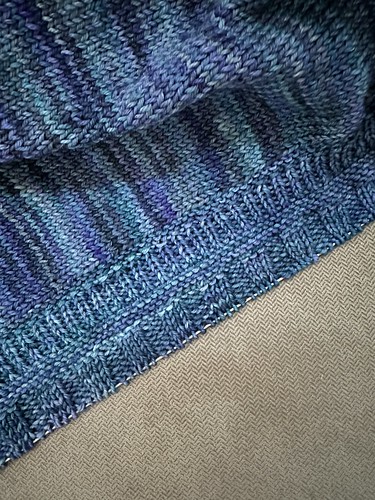
I finished up the body for the Minimalist Cardi! Because of the way the neckband works, you have to sew the shoulder seams up before you finish knitting the neckband. By adding back neck shaping, I changed the measurement of the back neck, so I couldn't follow the pattern exactly. I ended up knitting some of it, then sewing it down to the back neck (leaving the last inch or so free), and then knitting more of it to see where I was. Once the stitches on both sides were just one row apart, I Kitchener Stitched the middle back of the neck band and finished sewing the band to the back. It wasn't hard, just fiddley. You can see in the picture how the neckband wants to roll to the inside and I think that's going to be the best thing for it to do. I'm blocking the body now, just to get the neck/front bands trained the way I want them (this pic is pre-blocking which is why the sweater looks a bit squinky right now). I have opened up the front bands to almost their full width (I'm letting them roll in a bit to make the edge look finished), but around the neck, I'm letting the bands roll like they want to. I think it will fit my neck better that way than trying to keep them open all the way around.

I have started the sleeves, but I've already started messing with the pattern on them. If you look in the Ravelry section for this pattern, lots of people had trouble with the sleeves falling down and being longer than they wanted. The picture in IK shows them as 3/4 length sleeves, but since they get larger above the rib and make a blouson kind of shape, they need to be a bit longer than they look to get that "puff." If you look at the picture, you'll see that the model has her arms bent - could the sleeves be falling down on her and the bent arms was the way the stylist kept them in place? It's entirely possible that this is the case. For my own sleeves, I've decreased the stitch count for the ribbing (you do a huge increase when you start the seed stitch anyway, so a few more stitches won't matter) and I'm going to double check some measurements on myself before I decide how much sleeve to knit before I start the sleeve caps. For the size I'm making (35 1/2 inch bust), the total sleeve length as the pattern is written comes out almost to 19 inches. I've got to double check my shoulder bone to wrist bone measurement, but this sounds longer than 3/4 length sleeves, even allowing for a bit extra to puff.

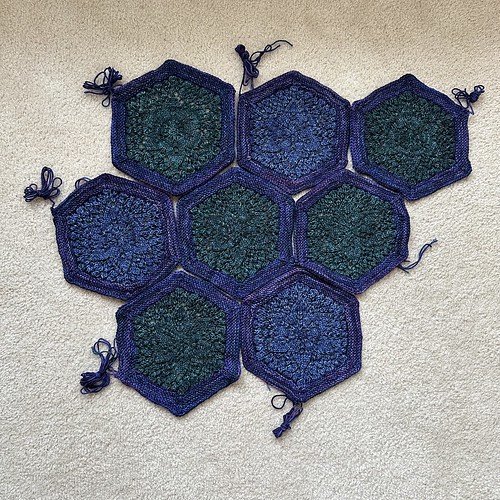
Oh, and since I was blocking the body of the Minimalist Cardi, I'm also finally blocking the Highly Modified Chinese Lace Pullover. It looks like I'm going to be doing some seaming this weekend!

Labels:

Tuesday, May 20, 2008

Spinning and a Book Everyone Should Take a Look At

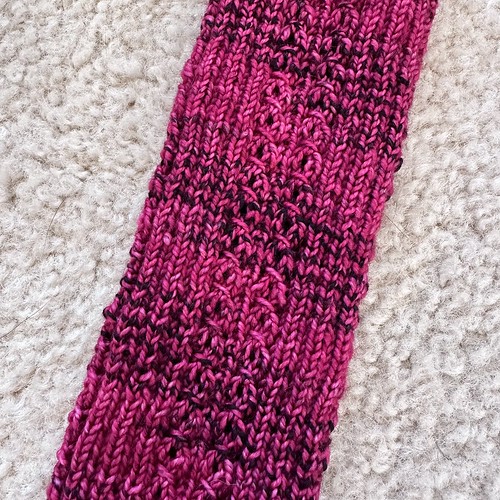
I feel like it's been ages since I did any spinning around here and I honestly don't really remember when I started this particular spinning project. This is the second bobbin (see, I really haven't been doing much spinning lately) of the Targhee roving. As you can see, it's making a textured kind of single and while a 3 ply yarn will even out some of the lumpy bumpys, the finished yarn will still have more texture than my usual yarn.

I also wanted to mention a book that's been discussed around the Internet in several different places: A Fine Fleece by Lisa Lloyd. This book seems to be described as a spinning book, but honestly, I think it's more of a knitting pattern book. There is some spinning information at the first of the book, but the majority of the book is patterns - mostly sweater patterns. I know what you're thinking and 9 times out of 10 I agree - why buy a hardback book of sweater patterns? In a year or two it will all be terribly datable and you won't want to knit the designs in it, right? In this case, it's a big, honking WRONG! Lisa's designs are firmly rooted in classic, traditional sweater design. They are updated a bit to make them more wearable today, but the timeless nature of the designs means this is a book that you will turn to for years to come. Each design is shown in both handspun and commercially available yarn so even if you're Sleeping Beauty and get violently ill around spinning wheels, you can still work these patterns. The other thing that's amazing about this book, and it's probably due to the classic nature of the designs, is the fact that I really like just about every design in the book. Most of the time, if I find more than half the designs interesting, I consider the book a good purchase, but this book has gems on every page. The biggest problem I see with it is deciding what design to start with!

Labels:

Monday, May 19, 2008

Minimalist Fronts

minimalist cardi fronts3


This weekend I did get some stealth knitting done, but I also got a big chunk of the Minimalist Cardi fronts worked on. I'm at least halfway up the armholes and I don't think it's going to be too much longer before I get the fronts finished. Then I have to sew up the shoulder seams and knit the front bands to the correct length to join them at the center back neck. Remember how I added back neck shaping? This also adds to the circumference of the neckline which means I need to knit the front bands longer than the pattern calls for. I plan to measure it along the neckline as I go to make sure I get it right.

I'm really amazed at how little yarn I've used so far on this project - I used one ball of yarn for the back and while I'm knitting on two balls for the two fronts, I've still got about half of each yarn ball left. I don't know if I'll be able to get the whole sweater made out of 3 balls of yarn, but the sleeves aren't long (they're 3/4 length) so I think it's possible. I actually bought 5 skeins of yarn so I've got plenty of yarn left, just in case you were wondering.

Labels:

Friday, May 16, 2008

More Minimalist - Is that a contradiction?

minimalist cardi fronts2


I got quite a bit done on the fronts of my Minimalist Cardi yesterday! At this point I'm about 20 rows away from armhole shaping. I plan on spending most of the weekend working on my stealth projects and maybe I can be back to regular blogging next week. I hope you guys all have a great weekend!

Oh, and just in case my uncaffeinated explanation the other day didn't make sense, here it is row by row.

Seed Stitch (over an odd number of stitches)
Row 1 and all RS rows: *K1, P1, rep from * to last stitch, end K1
Row 2and all WS rows: *K1, P1, rep from * to last stitch, end K1

Moss Stitch (over an odd number of stitches)
Row 1 (RS): *K1, P1, rep from * to last stitch, end K1
Row 2 (WS): *P1, K1, rep from * to last stitch, end P1
Row 3: *P1, K1, rep from * to last stitch, end P1
Row 4: *K1, P1, rep from * to last stitch, end K1

Labels:

Wednesday, May 14, 2008

Just a quick post today!

I don't have much to post about today since I spent yesterday working on the Fire Socks. The good news is that I've started the second design, so I hope to get the pattern finished up soon. The bad news is that I've planned two more stealth projects so you guys might be getting more Finn and Ramius than you usually do. (Not that I think you would mind, I think at least half of you are here for the furr baby blog days anyway! ;) )

Just to clarify, Seed Stitch is K1, P1 on the first row and all other RS rows and WS rows are worked as K the purls and P the knits. You have to pay attention to what you're doing on every row with that one. Moss Stitch is K1, P1 on Row 1, then the next row is K the knits and P the purls. Row 3 is P1, K1 (do the opposite of the stitch below it) and again the following row is K the knits and P the purls. You only have to think about what you're doing on RS (or odd numbered) rows - on the WS rows, you can go on autopilot. Hope that helps!

Tuesday, May 13, 2008

Minimalist Cardi Fronts

minimalist cardi fronts1


I've been working on the fronts to the Minimalist Cardi. I had been afraid when I started this sweater that I might have trouble with the moss stitch. Moss Stitch is related to Seed Stitch and I find Seed Stitch extremely fiddly to work. It doesn't help that I really like the way both stitch patterns look when knit. I decided to go ahead and knit the sweater because I really like the way it looks, and like I said, I really like the look of Moss Stitch in the knitted fabric. For some reason, it's not driving me nuts (maybe because unlike Seed Stitch, with Moss Stitch you only have to think about what you're doing on every other row) and I'm actually really enjoying it. I had more trouble with the ribbing, which is a K2, P1, than I'm having with the Moss Stitch.

There is some discussion on Ravelry about the front bands curling (they're in Stockinette Stitch), but so far, the curl seems to be minimal and I think when it's done and blocked, the curl will just give the front edges a finished look. The front bands might be doing different things in a different yarn though.

I hope the back neck shaping tutorial made sense and helped those of you who were wondering about it. I realize that it was a bit "wordy" (OK, I babbled for days), but I like to know not only the How but also the Why of something when I'm learning.

Labels:

Monday, May 12, 2008

Back Neck Shaping Tutorial

You asked for it, here it is.

If you look at the shape of the spine (scroll down to the second illustration) from the side, you can see that where the neck vertebrae and the thoracic vertebrae come together it curves to the back. The curvature of the spine is designed to handle the stresses, motions, and loads we place on it every day. The particular curve to the back at the base of the neck is what makes back neck shaping in a garment important. The vast majority of necklines will hit at this curve on the back of the neck. If the garment doesn't have some shaping along the back neckline (in other words, it goes straight across from shoulder to shoulder), the garment will fall backward to fit around the back neck curve. This is most noticeable in garments with larger front neck line shapes such as V necks, scoop necks and cardigans, which may or may not have closures, but are typically not fastened all the way up even when they do. We've all worn garments that fall back at the neckline and we spend all day pulling them forward, back into place. If the front neckline is a jewel neck, also a typical T shirt round neck, and the back neckline has no shaping, we won't spend the day pulling the garment forward so much as we'll spend the day feeling like our clothes are strangling us, because the smaller neckline area can't really go far enough to compensate for our natural spinal curve.

If you look at traditional folk knitwear you will find many examples of garments made without back neck shaping. We've learned a lot about shaping garments to the human body since then and have found that adding some back neck shaping is much more comfortable and flattering to wear. Now each designer has their own approach, and as I was looking through my books to figure out where I learned about back neck shaping and who's technique I was using (several places, and my own), I did find a note that back neck shaping can be avoided when you have a large collar. The theory behind that is probably that if you're going to add on all the extra for the collar, you'll eliminate any back neck shaping. I personally disagree, but this is my own personal feeling on the matter. Even on a garment with a hood (pretty much the biggest collar you can have), by adding back neck shaping, the hood itself will adapt to the curve of the spine. On the Minimalist Cardigan, there is a large collar that goes all the way down the front to the hem. This might, all by itself keep the cardi in place. I don't feel like taking the chance (because I hate clothes I have to fidget with and I'm too lazy to go back and redo a neckline after finishing the sweater), so I added back neck shaping.

I found a couple of books that dealt with back neck shaping and they both gave rules for figuring it out. Naturally, both of the rules were different, and since I figured the back neck shaping all by myself without looking it up, I made up my own rules. This just goes to prove that back neck shaping, like pretty much everything else in knitting can be done more than one way, so I'm not going to give you rules, I'm going to give you guidelines. If you've never changed anything about a pattern before, this is a good place to start - it doesn't take too much time, isn't too math intensive, and if you have long hair and really mess it up, no one will know. All you'll need is some paper and a pencil to make some notes with and a calculator if you don't trust your math. It doesn't take very long, so you don't even have to send the whole family out to pick up dinner (unless you want to, and really, that's not ever a bad idea when you get down to it).

The first thing you need to do is look at your pattern and figure out how many stitches you have after the last arm hole decreases are worked (these can be actual decreases or bind offs, depending on the pattern - just look for the stitch counts which are usually right before the sentence, "Continue working even until armhole measures X inches." If you've already begun your armholes, this is fine, but only work even until your armhole measures 1/2 of the X inches the pattern calls for before shoulder shaping, and then you can double check that your stitch count matches up with the pattern's.

The next thing you need to figure out is how many stitches are used in the shoulders (remember, there are two shoulders) and how many are used in the back neck. You should be able to say (2 x shoulder stitch count) + back neck stitch count = total stitch count after armhole decreases are completed. If this isn't adding up properly, double check your math and the pattern's math until you figure out for sure how many stitches go where. For the back neck shaping, you'll only be dealing with the back neck stitches so you have to know how many of them there are.

OK, here's where the guidelines come in. Your back neck shaping will usually be anywhere from 1" to 1/2" from the top of the shoulder shaping or final shoulder bind off. Most shoulder shaping takes up about 1/2" of the back length, so if you start your back neck shaping at the same time as the shoulder shaping, you'll end up with a back neck depth of about 1/2". I usually use 1" for my own back neck shaping because it gives me a little more spine space and means I definitely won't have to fidget with my garment. I don't really know of a nice way to say this, so I'll just say it: if you have a hunchback type of shape (I'm assuming if you do, you know this), you will want to have a deeper back neck shape than 1". This type of spine shape is more common among older women, but we are all different shapes and sizes. If you're honest with yourself about your own shape and size, you'll have better fitting garments and you'll look better than if you just pretend you don't have a bump on your back.

So, now you know how many stitches your back neckline will use in total and you know the depth your back neckline will be. Now we have to shape it. (You could theoretically just bind off the total neckline stitches at the correct depth and then continue working the shoulders as the pattern directs, but now you're putting a curve in a rectangular opening and if you're planning on picking up stitches to add a collar band of some sort later, you'll be unhappy with the way it goes around the corners. You'll be happier if you slope the back neck at least a little bit.) Since you know the depth of your back neck shaping, figure out how many rows you've got to use. This is where it's really nice if you've actually knit most of the back of the sweater, because you can measure the actual garment's row gauge instead of relying on a gauge swatch (gauge swatches lie sometimes). If you're getting 8 rows per inch and you're planning on a back neck depth of 1 inch, you've got 8 rows to do your back neck shaping in. If you're planning on a back neck depth of 1/2 inch, you've got 4 rows to do your back neck shaping in - see? Easy math!

I tend to write down the exact number of rows I have to work with in a list and then mark WS or RS so I can keep track of things while I figure the shaping. I like to bind off 75-80% of the total back neck stitches on the first row (make sure you bind off the center 75-80%, or your neck shaping won't be even). This is not set in stone of course - guidelines, remember. Then you have a couple of options. If you're working a shallower back neck (1/2 inch), you need to get the rest of the back neck stitches decreased pretty quickly. In that case, I might work a WS row even and then bind off the remaining stitches on each side of the center on the following two rows. If you're working a back neck of 1 inch deep, you can work your back neck exactly as I described above and actually work a few rows of shoulder stitches only (all the back neck stitches will be bound off by row 4) or you can work decreases at the neck edge for a few rows and spread your back neck shaping over more rows. (Don't forget, you can also combine decreases and bind offs - the possibilities are limitless, as long as you don't decrease or bind off more than the total number of stitches from the back neck.) Note that all theoretical row numbers used in the above examples go with the theoretical 8 rows per inch I used as an example in the previous paragraph - you have to use your own numbers because your sweater might be different.

The other thing to remember when you're doing this is that usually you will be working shoulder shaping for at least part of the time you're working back neck shaping (that dreaded instruction, "At the same time..." is important here), so make sure you don't get so wrapped up in your back neck shaping that you forget your shoulder shaping.

The first time you figure this out for a pattern, it might help to look at another pattern that does have back neck shaping and compare it to my notes, then you can see how back neck shaping is done with real numbers. It's not hard to do and if you sit down with your knitting and just follow the guidelines, you'll probably do just fine. The limited space involved in back neck shaping really cuts down on the amount of mistakes you can make, so go for it!

The two books I was able to find that discuss back neck shaping (and I know there's more, I just grabbed these two) were Deborah Newton's Designing Knitwear and the big Vogue Knitting book. Both discuss more design than just back neck shaping and if you find yourself tinkering with patterns a lot, or want to design your own sweater from scratch, you'll find them helpful. I personally prefer Newton's for just design instruction, but the Vogue Knitting is also good and covers a wider variety of subjects.